Wednesday, June 27, 2012

Minerals and Rocks.

Alright, so here goes another lesson we discussed, minerals and rocks. enjoy :)


Matter 
is anything that occupies space and has rest mass (or invariant mass). It is a general term for the substance of which all physical objects consist. Typically, matter includes atoms and other particles which have mass. Mass is said by some to be the amount of matter in an object and volume is the amount of space occupied by an object, but this definition confuses mass and matter, which are not the same. Different fields use the term in different and sometimes incompatible ways; there is no single agreed scientific meaning of the word "matter," even though the term "mass" is better-defined.


Mineral 
is a naturally occurring solid chemical substance formed through biogeochemical processes, having characteristic chemical composition, highly ordered atomic structure, and specific physical properties. By comparison, a rock is an aggregate of minerals and/or mineraloids and does not have a specific chemical composition. Minerals range in composition from pure elements and simple salts to very complex silicates with thousands of known forms. 


Mineral Is defined as to have the following characteristics:
  • 1.   Naturally occurring
  • 2.   Solid substance
  • 3.   Orderly crystalline structure
  • 4.   Definite chemical composition
  • 5.   Generally considered organic


How Minerals Form
  1. Crystallization from magma
  2. Precipitation
  3. Pressure and temperature
  4. Hydrothermal solutions


Mineral Groups 
-can be classified based on their compositions
  1. Silicates -  Silicon and oxygen combine to form a structure called the silicon-oxygen  tetrahedron. This silicon-oxygen tetrahedron provides the framework of every silicate  mineral.
  2. Carbonates -  Minerals that contain the elements carbon,oxygen, and one or more other metallic elements.
  3. Oxide -   Minerals that contain oxygen and one or more other elements, which are usually metals
  4. Sulfate and Sulfides -  Minerals that contain the element sulfur
  5. Halide -  Minerals that contain a halogen ion plus one or more other elements
  6. Native Element -  Minerals that exist in relatively pure form

Properties of Minerals
  • Color
    Small amounts of different elements can give the same mineral different colors.
  •     Streak
    is the color of a mineral in its powdered form.
  •     Luster
    is used to describe how to light is reflected form the surface of a mineral.
  • Crystal Form
    is the visible expression of a mineral's internal arrangement of atoms.
  • Hardness
    is a measure of the resistance of a mineral to being scratched.
Mohs scale cosist of 10 minerals arrange from 10(hardest) to 1(softest).
  • Cleavage
    is the tendency of a mineral to cleave, or break, along fat, even surfaces.
  • Fracture
    Minerals that do not show cleavage when broken are said to fracture. 
Fracture-the uneven breakage of a mineral

  • Density
    is a property o all matter that is the ratio of an object's mass to its volume.


Here is a video Identifying rocks and minerals.


Checked by Prof. Crisencio Paner


Saturday, June 16, 2012

Introduction

I see this world of ours for its beauty and art, it is what inspires me to keep moving forward.

I was always in a constant awe whenever I see such beautiful or even mysterious scenes in this world, sometimes I just want to break out from reality and explore the world for its beauty and be continuously inspired by all the places I could have seen and visited. Whenever I research something about this planet, whether through watching science channels on the television, through reading books or just by plainly researching it on web, there are always a time I thought and question myself on how everything was formed


There are a lot of questions and answers in this world and everything surrounds it, some are proven facts while some are just theories. Years will go by and we'll still wonder where it all started; The Big Bang, The Nebular, The Biblical, The Mayan, and so many others... everything was just a theory, somehow any person could establish their own theory like those old scientists do, but it'll forever be just a theory; unless some god bestowed you the power to know everything.


I think I was never really a fan of the science subject and I think I didn't do good on it too, until years went by, now I see the world by its beauty and mystery, and every time I wonder about it, some realizations hits my head. Everything became an inspiration, I became so curious on so many things that I started researching on everything I could think of. 


Everything what we have and see now are synthesized from this world, just like how art was formed, all artists' inspiration came from another artists to another but all creative work came from synthesizing what we see and know of the world; like magical creatures were inspired of animals or combining animals with other things, like the vampire were inspired from a bat and possibly the thought of human rising back from the dead, and to the world of Pandora (in the movie Avatar) which came out from what we could think of an alternate version of our world.


So again for the longest time, in my 3rd year of college in fine arts, we again have to study natural science, it could not be related to our course, but it could keep our mind exercised and somehow inspire us more on a lot of things. On the first meeting with our professor, he introduced us again to the world of Earth Science which includes the following:
  • Meteorology - Study of the atmosphere and the processes that produce weather
I was happy when I was able to find this video, I was amazed when our professor showed us this.


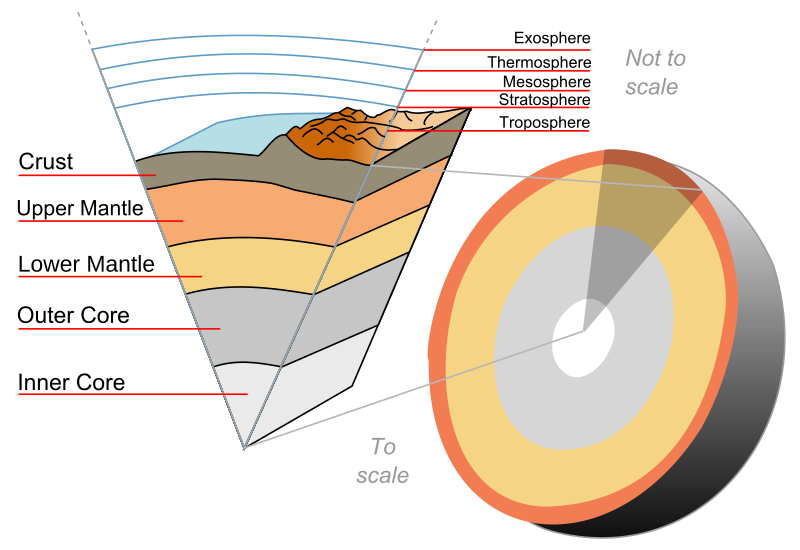
The Earth is composed of 4 major spheres:
  • Hydrosphere - The most prominent feature is the ocean, which is nearly 71% of Earth's surface and hold about97% of Earth's water.
  • Atmosphere - The thin, tenuous blanket of air and which on half lies below 5.6 kilometers.
  • Biosphere - Which includes all life on Earth.
  • Geosphere - Which consists of:
    • Crust - The thin, rocky outer layer of Earth.
    • Mantle - The 2890-kilometer-thick layer of Earth located below the crust.
    • Core -  The innermost layer of Earth, located beneath the mantle.

Somehow those are the prominent topics that we've discussed about in Earth Science on our first day, others include were:

Plate Tectonics, which is the theory that proposes that Earth's outer shell consists of individual plated that interacts in various ways and thereby produce earthquake, volcanoes, mountains, and Earth's crust itself.

Determining Locations of Earth, which the Latitude and Longitude lines are used on the globe to determine the location.


People and the Environment
  • Environment - Surrounds and influences organisms. the physical environment that encompasses water. air, soil and rock.
  • Resources - Includes water, soil, mineral & energy. which there are two broad categories:
    • Renewable
    • Non Renewable
  • Population -  The organisms that both belong to the same group or species and live in the same geographical area.
I was just so inspired on the world of science and to our professor, who has achieved every dream and has done greatly in life despite his disability to walk. Hopefully I can have my dreams achieved in the future.

Me being a concept artist who is constantly building another worlds from scratch through the inspiration of other works and this world we live in, needed to be taught more of this subject, as I said earlier, everything including creativity and art were synthesized form the world we live in.


My work which set on a different world,with a different historical background inspired by our own world and history :)


Alright, I think that is enough of my introduction. The world of science for other artists may be boring or just plainly unneeded in order to make a living, but for me, knowing everything about Earth and the life it gives can keep my imagination flowing, the entire world of Science is limitless just like how your imagination and creativity can be limitless as well.


P.S.
All thanks to our science professor, Mr. Crisensio Paner, for sharing his knowledge and being an inspiring person that lead me to do this blog :)